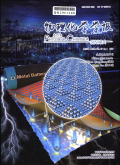
物理化学学报2024,Vol.40Issue(11):49-50,2.DOI:10.3866/PKU.WHXB202407014
引入内建电场强化BiOBr/C3N5 S型异质结中光载流子分离以实现高效催化降解微污染物
Improved Photo-Carrier Transfer by an Internal Electric Field in BiOBr/N-rich C3N5 3D/2D S-Scheme Heterojunction for Efficiently Photocatalytic Micropollutant Removal
摘要
Abstract
Photocatalytic wastewater decontamination techniques hold eminent promise in mitigating environmental deterioration,yet the lack of distinctive photocatalysts prevents their further large-scale application.Herein,an S-scheme heterojunction photocatalyst BiOBr/C3N5(BBN)was fabricated for efficiently dislodging micropollutants under visible light.Among the BBN samples,the optimal BBN-2 demonstrated exceptional activity in photocatalytic TC removal with a rate constant of 0.0139 min–1,which surpassed that of pure BiOBr and C3N5 by 0.6 and 2.8 times,respectively.The spatially segregated photoredox sites and efficient photo-carrier separation propelled by an internal electric field are found to play a cardinal role in promoting photoreaction kinetics.Moreover,BBN-2 exhibited remarkable resistance to environmental interference and stability,retaining a high activity level after five runs.Through active radical detection,·O2–,h+and·OH were identified as the primary active species in the photocatalytic reaction process.This research would encourage the exploration of C3N5-based photocatalysts for environmental protection.关键词
C3N5/S型异质结/微污染物去除/内建电场/光催化Key words
C3N5/S-scheme heterojunction/Micropollutant removal/Internal electric field/Photocatalysis分类
化学化工引用本文复制引用
游常俊,王春春,蔡铭洁,刘艳萍,竺柏康,李世杰..引入内建电场强化BiOBr/C3N5 S型异质结中光载流子分离以实现高效催化降解微污染物[J].物理化学学报,2024,40(11):49-50,2.基金项目
This work has been financially supported by National Natural Science Foundation of China(U1809214),the Natural Science Foundation of Zhejiang Province of China(LY20E080014,LTGN23E080001),the Open Research Subject of Zhejiang Key Laboratory of Petrochemical Environmental Pollution Control(2021Y02)and the Science and Technology Project of Zhoushan(2022C41011). 国家自然科学基金(U1809214),浙江省自然科学基金(LY20E080014,LTGN23E080001),浙江省石油化工环境污染控制重点实验室开放课题(2021Y02)舟山科技项目(2022C41011)资助 (U1809214)