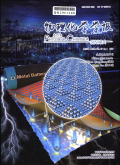
物理化学学报2025,Vol.41Issue(6):50-63,14.DOI:10.1016/j.actphy.2025.100053
层状MoS2/Ti3C2Tx异质结光热转换材料用于太阳能驱动水蒸发
Hierarchical MoS2/Ti3C2Tx heterostructure with excellent photothermal conversion performance for solar-driven vapor generation
摘要
Abstract
Metallic 1T Molybdenum disulfide(1T-MoS2)exhibits enhanced full spectral light absorption and prominent electrical conductivity,making it ideal for photothermal applications in conjunction with Ti3C2Tx MXene.Despite the challenges in increasing the 1T-MoS2 proportion within MoS2/Ti3C2Tx heterostructures and the incomplete understanding of the mechanisms governing their formation and properties,herein,a combined theoretical and experimental framework has been established,suggesting that the metallic characteristics of Ti3C2Tx and 1T-MoS2 could significantly improve photothermal performance through strong interlayer interactions and efficient electron transport.The hierarchical MoS2/Ti3C2Tx heterostructure has been fabricated through a one-step hydrothermal synthesis method with enhanced 1T-MoS2 proportion,which achieves multilayered wrinkled architecture resulting from the in-situ growth of MoS2 on Ti3C2Tx nanosheets.Notably,a remarkable peak photoheating temperature of 107 China under an 808 nm laser with an intensity of 0.5 W·cm-2 is realized,demonstrating its exceptional photothermal conversion capability.By incorporated into a polyvinylidene difluoride membrane,the MoS2/Ti3C2Tx heterostructure functions as an efficient self-floating solar-driven steam generator,reaching an evaporation rate of 1.79 kg·m-2·h-1 and an evaporation efficiency of 96.4%under one solar irradiance.This study proposes a versatile strategy for the MoS2/Ti3C2Tx heterostructure,offering the potential for sustainable solar-driven vapor generation technologies.关键词
MXene/二硫化钼/异质结/光热转化/太阳能驱动水蒸发Key words
MXene/Molybdenum disulfide/Heterostructure/Photothermal conversion/Solar-driven vapor generation分类
化学化工引用本文复制引用
荣坤,孙志梅,温翠莲,闻健森,李雄,廖秋刚,鄢思情,许超,张晓亮,萨百晟..层状MoS2/Ti3C2Tx异质结光热转换材料用于太阳能驱动水蒸发[J].物理化学学报,2025,41(6):50-63,14.基金项目
The project was supported by the National Key Research and Development Program of China(2022YFB3807200),the National Natural Science Foundation of China(52332005),and the Natural Science Foundation of Fujian Province(2024J01262).国家重点研发计划(2022YFB3807200),国家自然科学基金(52332005)及福建省自然科学基金(2024J01262)资助项目 (2022YFB3807200)